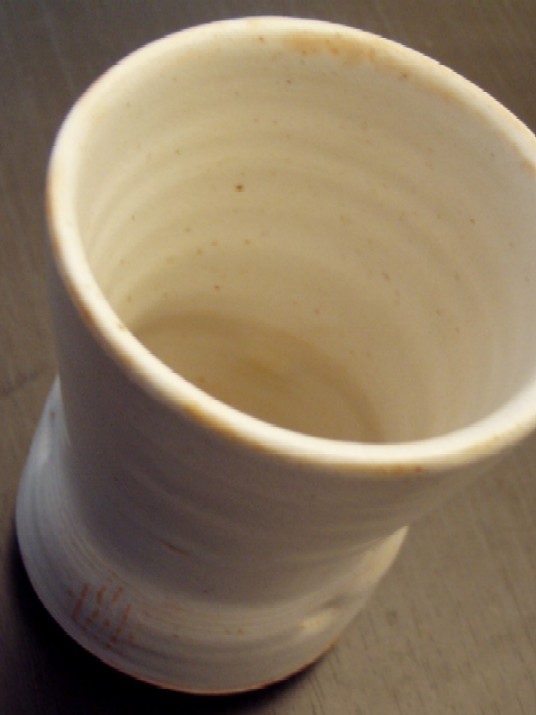
soul of a bowl
Houston Center for Contemporary Craft has a superb exhibit of bowls thru November 13th. Friday I had the good fortune to be able to visit the center and see them. The gallery features five ceramic artists Frank Boyden, Elaine Coleman, Tom Coleman, Jenny Lind and Don Reitz.
During my visit, Initially I loved the first ones I saw - very elegantly formed cups by Tom Coleman. porcelain. cone 10. wood fired. shino glazes, dry ash, orange shino over copper slip, crystal matte glaze sprinkled with dry ash. I made notes. I thought I might buy some porcelain to try it. Never hurts to try. The Tom Coleman cups were lovely shapes. Very light, trim pieces. thrown. altered some but not mutilated. the rims were light a bit squared off here and there, undulating very slightly, gracefully.
As I moved on to the next case, I really made a connection with the pieces by Jenny Lind when I tried to sketch the art featured on the inside and outside in reds and blacks, greys and whites. I enjoyed the white shore bird forms. The line drawings of white horses, white hands with red nails and a galloping yellow cheetah featured on the surfaces of the different Lind bowls held my attention as I tried to imagine how to brush engobes in such fine lines and draw birds and horses with such nice movement. The lines on the Lind pieces were so fine they could have been made with a pen tip. Then I studied the bowls for color use. Some had a bold red glaze inside, black outside some appeared to be orange and some had white brush strokes on black creating a washy grey tone. Each Lind bowl had this lovely art inside and out. One featured a robin painted inside the bowl, very Audubon. The robin, in very bright color and detailed brush strokes, was painted from the top view. As you peek into the bowl it's as if you are looking into a nest.
I found sketching the Boyden pieces, pleasing as they were small sensual shapes with delicate but luscious curves and bumps. To sketch them and I had to focus in and concentrate on the wavy form which was a joy. I found that I liked them even more than the Tom Coleman cups, because of the random way Boyden gently alters the piece, nudging the thrown cup out in finger-sized nodules, creating lovely curves and shadows inside and outside the cup. The Boyden cups were wood-fired porcelain cone 12, no glaze. I again made a note to try porcelain someday.
Next, I studied and sketched the Don Reitz bowls. My companions grew restless. They were larger and rougher even clunky compared to both Tom Coleman and Boyden's. Reitz constructs his cups of white stoneware, wood fired, slip decorated, shino glaze inside cone 10 to 12. The cylider forms held slight alterations. Some wore carved geometric marks - square rectangle diamond - centered like a crest. While some had horizontal marks like a belt cinching in a waistline. The most striking feature of the Reitz pieces was the amount and variation of color each bowl carried including blasts of rust, red-orange and garnet-red along side the grey, yellow-green and white speckled surfaces. Note: Be sure to bring portable watercolors or color pencils if you have them - because these pots will make your sketchbook long for more color.
Finally, the last artist in the soul of a bowl was Elaine Coleman. Mouthwateringly fluid and beautifully carved porcelain cups with cool green transparent celadon glazes that melt your eyes. Newts, draped and overlapping - winding flora and fauna, moths- too ubelieveably beautiful to be real. thats all I can say.
During my visit, Initially I loved the first ones I saw - very elegantly formed cups by Tom Coleman. porcelain. cone 10. wood fired. shino glazes, dry ash, orange shino over copper slip, crystal matte glaze sprinkled with dry ash. I made notes. I thought I might buy some porcelain to try it. Never hurts to try. The Tom Coleman cups were lovely shapes. Very light, trim pieces. thrown. altered some but not mutilated. the rims were light a bit squared off here and there, undulating very slightly, gracefully.
As I moved on to the next case, I really made a connection with the pieces by Jenny Lind when I tried to sketch the art featured on the inside and outside in reds and blacks, greys and whites. I enjoyed the white shore bird forms. The line drawings of white horses, white hands with red nails and a galloping yellow cheetah featured on the surfaces of the different Lind bowls held my attention as I tried to imagine how to brush engobes in such fine lines and draw birds and horses with such nice movement. The lines on the Lind pieces were so fine they could have been made with a pen tip. Then I studied the bowls for color use. Some had a bold red glaze inside, black outside some appeared to be orange and some had white brush strokes on black creating a washy grey tone. Each Lind bowl had this lovely art inside and out. One featured a robin painted inside the bowl, very Audubon. The robin, in very bright color and detailed brush strokes, was painted from the top view. As you peek into the bowl it's as if you are looking into a nest.
I found sketching the Boyden pieces, pleasing as they were small sensual shapes with delicate but luscious curves and bumps. To sketch them and I had to focus in and concentrate on the wavy form which was a joy. I found that I liked them even more than the Tom Coleman cups, because of the random way Boyden gently alters the piece, nudging the thrown cup out in finger-sized nodules, creating lovely curves and shadows inside and outside the cup. The Boyden cups were wood-fired porcelain cone 12, no glaze. I again made a note to try porcelain someday.
Next, I studied and sketched the Don Reitz bowls. My companions grew restless. They were larger and rougher even clunky compared to both Tom Coleman and Boyden's. Reitz constructs his cups of white stoneware, wood fired, slip decorated, shino glaze inside cone 10 to 12. The cylider forms held slight alterations. Some wore carved geometric marks - square rectangle diamond - centered like a crest. While some had horizontal marks like a belt cinching in a waistline. The most striking feature of the Reitz pieces was the amount and variation of color each bowl carried including blasts of rust, red-orange and garnet-red along side the grey, yellow-green and white speckled surfaces. Note: Be sure to bring portable watercolors or color pencils if you have them - because these pots will make your sketchbook long for more color.
Finally, the last artist in the soul of a bowl was Elaine Coleman. Mouthwateringly fluid and beautifully carved porcelain cups with cool green transparent celadon glazes that melt your eyes. Newts, draped and overlapping - winding flora and fauna, moths- too ubelieveably beautiful to be real. thats all I can say.
posted by marcia at 3:41 PM
1 comments